|
|
|
Issue No. 007 | Friday, June 12, 2026 | The Space Issue
|
|
|
Was this forwarded to you?
Subscribe free at manufacturingmonitor.com
|

|
|
Today's Clock-In
SpaceX goes public today. We're covering it as a manufacturing story, because it is one.
Last night, SpaceX priced the largest IPO in history: $135 per share, roughly $75 billion raised, a valuation near $1.77 trillion. It starts trading on the Nasdaq today as SPCX.
The financial press will cover the pop. We're covering the production line. So this week, the whole issue goes to space: Blue Origin commits $600M to a new Florida plant weeks after losing a rocket on the pad, the Space Force hands SpaceX $2.29B for a military data mesh, and May's jobs report keeps manufacturing in the green.
In this issue, we'll get into
- Why the $1.77T SpaceX IPO is a bet on a space factory
- How rocket propellant tanks actually get made
- Three under-the-radar American shops holding up the space supply chain
- Why Pathfinder is the space-business podcast worth your commute
|
|
Quick Hits
Blue Origin is putting $600M into a new Cape Canaveral rocket plant.
Project Horizon, announced in late May, is an 830,000 sq ft facility for New Glenn upper stages, adding roughly 500 jobs at an average salary above $98,000.
Upper stages are expendable, so every launch consumes one. This is Blue Origin buying capacity for a launch rate it does not yet have.
A fully fueled New Glenn was destroyed on the pad two weeks ago.
On May 28, the NG-4 rocket exploded during prelaunch testing, destroying the vehicle, 49 Amazon Leo satellites, and damaging the pad. No injuries. Outside estimates put recovery at 12 to 18 months.
Read these two stories together. One pad, one vehicle at a time is a fragile production system. The $600M plant is the admission that resilience comes from rate.
The Space Force awarded SpaceX $2.29B to build a military internet in orbit.
The Space Data Network Backbone: an optically linked mesh of Starshield satellites routing military data through space instead of ground relays. Operational prototype due by end of 2027.
The Pentagon is not buying launches here. It is buying satellite manufacturing capacity, and only one company prints satellites fast enough to bid this with confidence.
Manufacturing added jobs again in May.
Friday's report showed 172,000 jobs added, roughly double consensus. Manufacturing added 7,000 against expectations of 2,000, and prior months were revised up by a combined 93,000.
After May's strong PMI, the labor data now confirms it. The factory expansion has legs.
|
|
Lead Story
$1.77 Trillion for a Space Factory
SpaceX priced its IPO Thursday night at a fixed $135.00 per share. No range, no book-building. Take it or leave it.
Wall Street took it. The 555.6 million share offering raised about $75 billion, roughly three times Saudi Aramco's 2019 record, at a valuation near $1.77 trillion. An unusually large 30% slice was reserved for retail investors.
Most coverage will debate the price. Morningstar says far too high, ARK says far too low. Both are opinions.
The facts are in the S-1. And the S-1 describes a factory.
|
What's an S-1?
The registration statement a company files with the SEC before going public, and the first time a private company must open its books: audited financials, segment results, operational details. SpaceX filed its S-1 on May 20, ending two decades of guesswork.
|
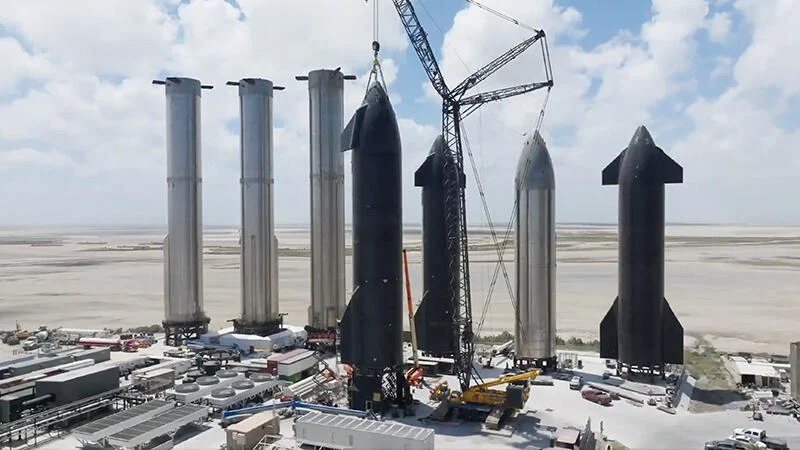
Start with the production metrics. Redmond, Washington averaged 70 Starlink satellites per week this spring. Bastrop, Texas builds roughly 15,000 terminals per day. SpaceX has built more than 600 Raptor engines. Falcon 9 flew 165 missions in 2025, more than every other organization on Earth combined. China, the entire country, flew 92.
Now the money. Starlink generated $11.4B of the $18.7B in 2025 revenue, with $4.4B in operating income. Launch ran a deliberate loss while Starship absorbed over $15B in development. The AI segment, folded in via February's xAI merger, lost over $6B and explains the consolidated $4.9B net loss.
The profit center is not launch. It is a satellite and terminal factory that happens to own its own delivery trucks.
Every layer is vertically integrated: engines, tanks, avionics, satellites, terminals, pads. Starbase was sized, by the company's own description, to eventually build up to 1,000 Starships per year. Whether it gets there is a fair question. That it was designed around the question at all is the difference between SpaceX and everyone it competes with.
The contrast arrived on schedule. Two weeks before this IPO, Blue Origin lost a fully assembled New Glenn in a single pad event. Build one vehicle at a time, and one bad day erases your year. Build at rate, and a bad day costs you one unit.
One caveat for the file: Senator Warren asked the SEC this week to delay the offering over the valuation, dual-class control, and forced index buying. It didn't stop the deal, but governance questions tend to resurface when one person holds the wheel this tightly.
Today, public markets price an American space factory for the first time. Watch what they decide rate production is worth.
|
|
How It's Made
Rocket Propellant Tanks
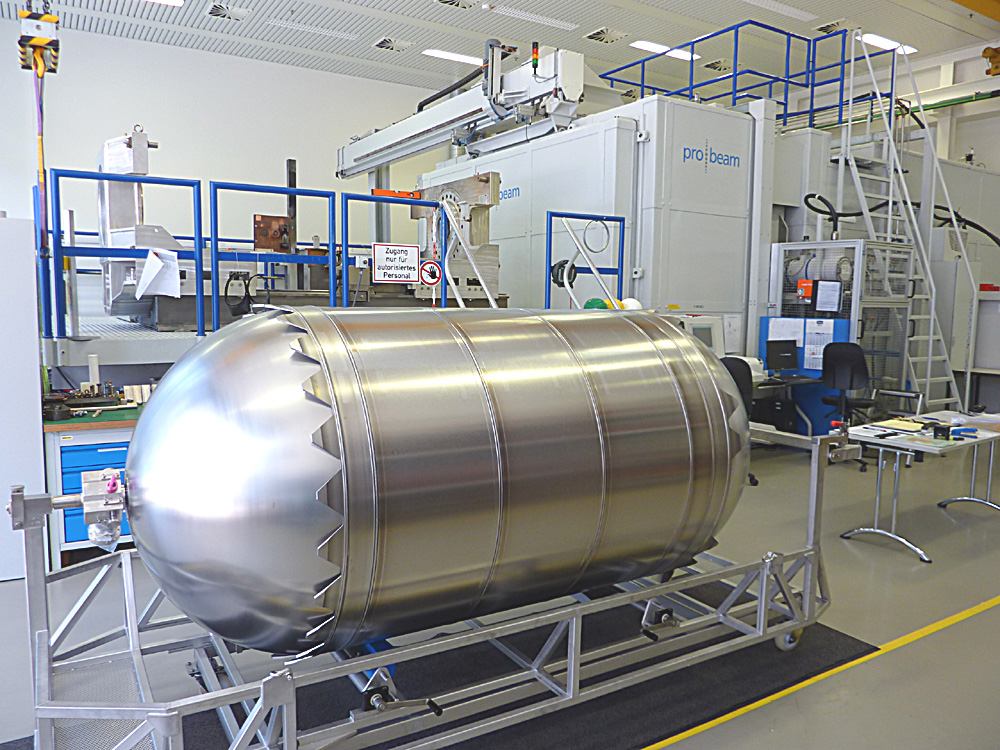
Here is the thing most people miss about rockets: there is no fuselage with tanks bolted inside.
The tank IS the rocket. It is the airframe itself, carrying flight loads while holding cryogenic liquids at minus 300°F.
Which means tank build rate is rocket build rate. Here is how they get made.
1. Pick the material.
The traditional choice is aluminum-lithium 2195, developed in the 1990s to lighten the Shuttle's external tank and still flying on the SLS core stage. SpaceX went the other way on Starship: cheap stainless steel, easy to form, easy to weld, strong at both cryogenic and reentry temperatures. Rocket Lab's Neutron takes the third path, carbon composite.
Musk's argument for steel was never about performance. It was about buildability.
2. Form the barrels and domes.
Flat plate gets roll-formed into curved barrel panels and rings. The end domes are spin-formed, stretch-formed, or built from pie-slice "gore" panels welded together. The scale is enormous: an SLS tank barrel is 27.5 feet across.
3. Machine the isogrid.
Aluminum panels start as thick plate, and most of it gets milled away, leaving a thin skin with an integral lattice of triangular ribs. Maximum stiffness, minimum mass, zero fasteners. The tolerances are brutal: a rib milled 0.002 inches too thick, repeated across a vehicle, adds hundreds of pounds.
4. Friction stir weld it together.
The step that changed rocket building. Invented at the UK's Welding Institute in 1991, friction stir welding plunges a rotating tool into the seam and drags it along the joint. Friction plasticizes the metal and forges it together. Nothing melts. That matters because aluminum-lithium alloys crack when fusion welded; FSW flew on the Shuttle's lightweight tank and joins SLS core stages today.
A forged weld is stronger, cleaner, and repeatable enough to automate. FSW turned tank welding from an art into a machine tool operation.
5. Insulate. Or decide not to.
Cryogenic propellants boil off, so aluminum tanks get spray-on foam, the orange coat on the Shuttle and SLS. Starship skips foam entirely. Steel tolerates the extremes, and deleting a process step is itself a production decision.
6. Proof test and inspect every inch.
Tanks get pressurized past flight loads, chilled for cryo proof tests, and every weld gets X-ray or ultrasonic inspection. SpaceX famously burst early Starship test tanks on purpose. The data from a burst tank is worth more than the tank.
7. Add the internals and integrate.
Slosh baffles go in so hundreds of tons of moving liquid cannot throw the vehicle off course, often with a shared "common bulkhead" between the oxygen and fuel tanks. Then feed lines, sensors, and pressurization, and the tank becomes a stage.
No separate fuselage ever shows up. It was the tank all along.
|
The manufacturing lesson
Because the tank is the airframe, tank rate equals vehicle rate. Every launch company's real bottleneck lives in this process, not on the pad. SpaceX did not pick steel because it is the best aerospace material. It picked steel because it is the best material for building tanks fast, outdoors, by the hundreds.
Optimize the part for performance, and you build one a year.
Optimize it for production, and you build a fleet.
|
Sources:
NASA friction stir welding primer,
IMDEA Materials on Starship steel.
|
|
Shop Floor Spotlight
Three American Shops Holding Up the Space Supply Chain
SpaceX builds nearly everything in-house. Almost nobody else does. Behind every other American rocket is a layer of mid-sized manufacturers worth knowing:
AMRO Fabricating · South El Monte, California
A third-generation, family-owned shop of about 200 people that machines the isogrid tank panels for the SLS core stage and structural panels for Orion. Those 0.002-inch tolerances from Step 3? This is who holds them. The Moon rocket starts in a Los Angeles County machine shop.
Ursa Major · Berthoud, Colorado
America's pure-play merchant rocket engine company, roughly 400 employees, selling propulsion to anyone who needs it. Its Hadley engine powers Stratolaunch's hypersonic Talon-A, its Draper engine first flew in January, and it raised $100M in November to scale. If you are not SpaceX, this is increasingly where your engine comes from.
Janicki Industries · Sedro-Woolley, Washington
A privately held composite tooling powerhouse, about 1,900 employees, behind the molds for NASA's composite cryotank demonstrator and the SLS payload fairing. Last week it announced an $830M Montana expansion adding 1,000+ jobs over five years.
Honorable mention: Karman Space & Defense, which makes payload protection and interstage structures for Orion and SLS. It was under-the-radar too, until its 2025 IPO. It posted a record quarter last week and trades near an $8B market cap. Machine shop, supplier of record, public company. The space supply chain is minting them.
|
|
Suggested Listening
Pathfinder, hosted by Mo Islam of Payload
Pathfinder is the weekly interview show from Payload, the space industry's business-news outlet, and it covers space the way we cover factories: as an industry with customers, margins, and production constraints, not a spectacle.
Host Mo Islam, Payload's co-founder, runs hour-long conversations with the people who actually operate the sector: launch and satellite CEOs, founders, investors, and policymakers. Recent episodes have broken down exactly this issue's topics, from how SpaceX's revenue splits to how defense demand is reshaping space manufacturing.
It slots neatly into the rotation. TBPN for the venture lens. Odd Lots for the physical-economy lens. Pathfinder for the industry where both collide at 17,500 miles per hour.
Sources:
Payload Pathfinder,
Apple Podcasts.
|
|
Last Pull
One more number from this week, and it was not about space.
Thursday's Producer Price Index showed input costs up 6.5% over the past year, the hottest reading since late 2022. Aluminum scrap, jet fuel, and industrial chemicals were among the categories moving. Those are aerospace inputs.
On the same day, investors paid $75 billion for a company defined by one trait.
It makes almost everything itself.
When your engines, tanks, satellites, and terminals all come from your own floor, a supplier's price increase is a line item you can engineer around. That is part of what $1.77 trillion is buying: insulation from everyone else's cost structure.
But vertical integration cuts both ways. Own the whole stack and you own every problem in it. Blue Origin learned the price of concentration on May 28. AMRO, Ursa Major, and Janicki exist because most companies cannot and should not build everything.
In a rising-cost decade, make-versus-buy is back.
And it is now a strategy question, not a procurement one.
|
Reply with one line
With input costs running this hot, is vertical integration the only real hedge, or a trap where you end up owning everyone's problems?
|
Forward this to a colleague who lives on the floor. Subscribe at manufacturingmonitor.com.
|
|